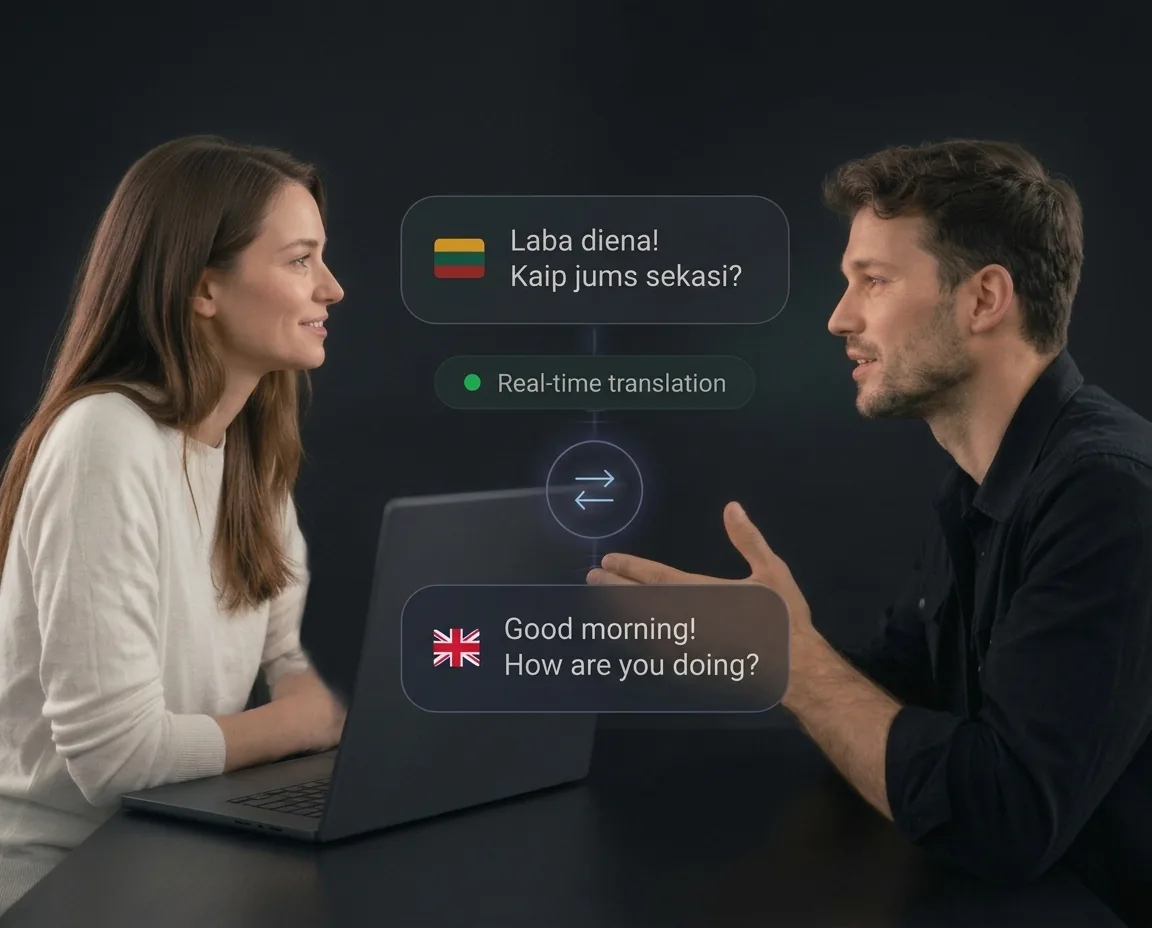
Job interviews
Follow every question, even in a language you are still learning. Accuracy matters more than speed here — so that is what we optimise for.
SubLive is a Chrome extension that turns live speech into translated subtitles in any tab: interviews and calls, lectures and webinars, live streams, videos and podcasts. Anything Chrome plays, you read in your own language — the spoken language is detected automatically.
Free minutes after you confirm your email. No card required.

Meetings are only the loudest case. SubLive captions any audio your browser plays — same extension, same floating window, whatever is in the tab.
Follow every question, even in a language you are still learning. Accuracy matters more than speed here — so that is what we optimise for.
Stop nodding along. Read what was actually said, with the terminology your team uses, straight from your own glossary.
A university recording, an online course, a webinar you joined late. Keep up with a lecturer speaking another language, and keep the transcript afterwards — if you choose to save it.
A live stream cannot be downloaded and translated later — it is understood now or not at all. Twitch, YouTube Live, news and sport get subtitles while the words are still being spoken.
A video with no subtitles, a podcast in the web player, an audiobook. Read it in your language — or in both at once, which is how people use it to learn one.
Family calls in a web messenger, an appointment with the bank, a city council stream. The conversations you cannot postpone until your language gets better.
Read more:Meetings and callsLectures and coursesLive streamsVideos and podcasts
Chrome 116 or newer.
The spoken language is detected automatically. You never have to guess it.
Captions appear in a floating window that stays above other tabs and other apps.
The core of SubLive: live subtitles in your language, wherever the sound plays, in a window that stays where you put it.
Live subtitles in 61 languages, a sentence behind the speaker at most.
Google Meet, Zoom Web, webinars, online courses, live streams, YouTube and podcasts — no bot to invite, no app to install.
A floating subtitle window above other tabs and apps, or an overlay on the page itself.
Add these when more than one person is in the conversation — who said what, shared terms, and a record everyone can find afterwards.
Names, products and terms translated the way your team actually uses them.
One running line of captions, or the conversation split by speaker and labelled — SubLive tells the voices apart.
Hand out a code and someone else runs subtitles from your balance. You see how many are on it and revoke it in a click.
Save a lecture or a call and ask for a summary of it: what it was about, what was decided, what is still open. Saving is off until you turn it on.
Switch it on and every finished conversation arrives as an email — the summary and a link to the full text, without opening the site.
For companies
Company accounts save calls and meetings on purpose. Once an administrator turns it on, the AI tools your team already uses — Claude, Cursor, your own agent — can read that archive: find a conversation, summarise it, pull out what was decided. No new dashboard to learn, just the assistant you already have.
"Which calls with Acme mentioned the renewal?" — search across everything your company saved.
Minutes, a CRM update, a weekly digest — written from the summary, not typed from memory.
Off by default, one switch to turn it on, every read logged, and an agent only ever sees what the person behind it may see.
Comes with every company account — closed until an administrator switches it on.
No seats and no per-person licences. Buy hours once and they stay on your balance until you use them, or take a monthly plan where the hours refresh every month. Your first minutes are free.
€15one-off
5 hours of subtitles
€3.00 per hour
€40one-off
15 hours of subtitles
€3.00€2.67 per hour
€60one-off
25 hours of subtitles
€3.00€2.40 per hour
Pin SubLive next to the address bar. Pick the language you want to read, hit start, and translated subtitles appear over the tab you are already in — no separate app, no meeting bot, no downloads.
Read the security page and the list of subprocessors. We name every third party that can touch your data.
61 languages: most official EU languages, the Balkans, Arabic, Russian and Ukrainian, plus Japanese, Korean, Chinese (Simplified, Traditional and Cantonese), Hindi and nine other languages of India, and a growing list of others including Hebrew, Indonesian, Thai and Vietnamese. Ten spoken languages are detected automatically; for the rest you name the spoken language once. See the full list on our languages page.
Yes. SubLive captions any Chrome tab that plays audio, so Google Meet, Zoom Web, Microsoft Teams in the browser, webinars, YouTube and podcasts all work the same way. There is nothing to invite to the meeting and nothing to install besides the extension.
Yes. SubLive captions whatever audio the tab is playing, so videos, live streams, online courses, podcasts and radio work exactly like a meeting does. Live streams are the case people ask about most: there is nothing to download and translate afterwards, so the subtitles have to arrive while it is being said.
No. SubLive hears Chrome tabs, not other applications on your computer. Join the meeting in the browser instead — Zoom Web, Teams in the browser, Google Meet — and everything works. What gets translated is only ever the audio a tab is already playing — your own microphone is used only if you switch on saving a conversation and then ask for your replies to be part of it, and even then it is never translated.
No — SubLive reads the audio your browser already plays. That is exactly why you are responsible for having the consent your jurisdiction requires. Read the Recording & Consent notice.
No. Audio exists only in memory while a sentence is being processed. Text transcripts are saved only if you turn that on, and they expire automatically.
The extension keeps the last 10 seconds of audio and re-sends whatever the server did not receive, so the conversation does not lose a sentence.
Yes. Installing is free and you get free minutes after confirming your email — no card required. After that you buy hours of subtitles. The smallest pack is 5 hours for €15, which is €3 an hour; 25 hours cost €60, which is €2.40 an hour. Hours bought this way never expire. If you use SubLive every week, a monthly plan is cheaper per hour — those hours refresh each month and unused ones do not carry over.
SubLive is built for Google Chrome 116 or newer and works in Chromium-based browsers such as Edge, Brave and Arc. Safari and Firefox are not supported yet.
Yes. Create a code in the extension, choose how long it stays valid and hand it out. Anyone who enters it runs subtitles from your balance, you see how many people are using it, and you can revoke it at any moment. Their time is spent at the same rate as yours, so two people translating at once use two minutes per minute.
You pay for the time subtitles are switched on, counted in 15-second steps — not per translated sentence. Pausing stops the meter: minutes spent on pause cost nothing, and resuming continues the same session rather than starting a new one.
Yes. Dialog mode separates the conversation by voice and labels each turn, so a three-way call reads like a chat instead of one unbroken block of text. If you would rather have a single running line of captions, subtitle mode does that instead — you switch between them in the extension.
Font, size, number of lines on screen, text and background colour, opacity, shadow and auto-hide are all in the extension settings, and the subtitle window can be dragged and resized. You can also show the recognised original under each translation — the first thing most people learning the language turn on.
Yes, on a company account. Ask Claude, Cursor or your own agent to find a call, summarise it, or turn last week's conversations into a report — the same way you'd ask a colleague. Under the hood, that's SubLive's MCP server reading the archive your company saved: an administrator turns it on, every read is logged, and an agent only ever sees what the person behind it may see. See the MCP page.
SubLive is a live translation extension for Google Chrome that turns speech into real-time subtitles in 61 languages. Install it once and it works inside the tab you are already using — video calls in Google Meet or Zoom Web, webinars, online lessons, job interviews, customer support chats and streaming video. There is no meeting bot to invite, no desktop application to install and no configuration beyond choosing the language you want to read.
The extension detects the spoken language automatically and shows translated captions in a floating window or as an overlay on the page itself, so conversations keep their natural rhythm. Teams use SubLive for multilingual standups and client calls, students use it for lectures held in another language, and support agents use it to answer customers in their own words. Audio is processed in the moment and is never stored; transcripts are saved only when you explicitly turn the option on.
Pricing works two ways, and you pick the one that fits. Buy hours once — 5 hours for €15 at €3 an hour, or 25 hours for €60 at €2.40 — and they stay on your balance with no expiry date. Or take a monthly plan, from €35 for 15 hours a month at €2.33 an hour, where the hours refresh every month and unused ones do not carry over. Companies buy in 50- and 200-hour steps, one shared balance for the whole team, either way. Add SubLive to Chrome for free and start your first translated conversation in under a minute.
The session stays under your control while it runs. Captions can be a single running line or a dialog split by speaker, shown in a floating window that stays above other applications or as an overlay on the page itself; font, size, colours, opacity and the number of lines are adjustable, and the recognised original can sit under each translation. Pausing stops the meter, so nothing is spent while nobody is talking. When speech has music or background noise behind it, naming the spoken language yourself keeps recognition steadier than leaving it to detection. And a code created inside the extension lets a colleague, a client or a student run their own subtitles from your balance — for as long as you allow, and no longer.